Home › Services
Line Striping & ADA Layout
The cheapest line item on most asphalt projects, and the one people actually judge the property by.
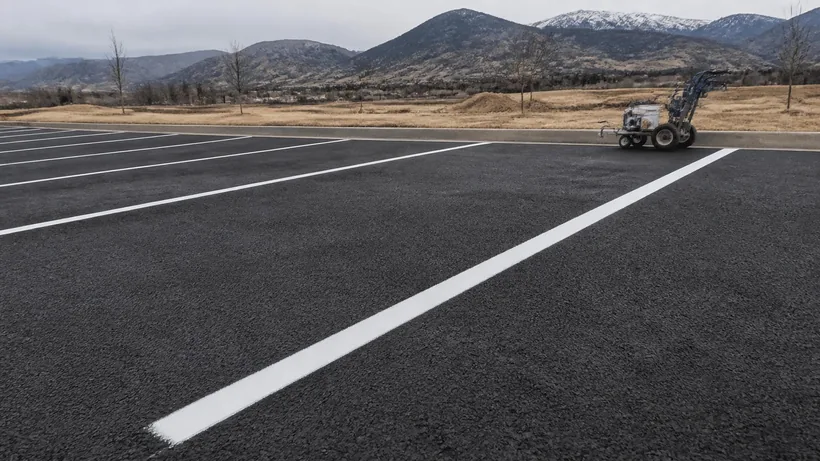
Striping is operational, not decorative
Markings do three jobs at once, and only one of them is appearance.
They organize the property: how many cars fit, how they circulate, where they enter and leave, where they are not supposed to go. A layout that works moves vehicles through a site without conflict. A layout that does not produces backed-up entrances, blocked aisles and cars parked in places that were never intended to hold them.
They handle pedestrians: crossings, walkways and the routes people take from the far end of the lot back to the door. On a busy property this is a safety function rather than a design flourish.
And they carry the accessibility requirements, which is the part with real consequences attached and the part most likely to be reproduced from a decades-old layout without anyone asking whether it still works.
Because striping is inexpensive relative to the rest of an asphalt budget, it tends to be treated as an afterthought. That is backwards. It is the cheapest opportunity on the whole property to fix how the site actually functions.
What a Colorado winter does to paint
Markings here face three attacks that a milder climate does not deliver in the same combination.
The first is mechanical. A plow blade is a steel edge dragged across the surface, and it takes paint with it. A lot plowed repeatedly over a season comes out of spring with markings visibly worse than traffic alone would explain, and the damage concentrates where the plow runs rather than where the cars do.
The second is chemical. De-icing products sit on the surface in solution and attack both the marking material and, over time, the binder in the pavement underneath. Magnesium chloride and similar products are effective on ice and unkind to everything they are applied to.
The third is ultraviolet. At this elevation the sun is harder on materials than it is at sea level, and paint fades faster for the same reason asphalt grays faster.
The practical consequence is that a striping cycle borrowed from a national average is wrong here. Condition after the winter, not a number of months, should drive when a lot is restriped — and the inspection worth doing is in early spring, when the season has just finished doing its damage.
Material choices and what they trade
There is a real choice between marking materials, and it is a durability-against-cost trade rather than a right-and-wrong one.
Conventional traffic paint is inexpensive, fast to apply, quick to dry and well understood. On a lot that will be resurfaced in a few years, or a lot where the layout may change, it is frequently the sensible answer precisely because it is not permanent.
More durable materials cost more up front and last longer under traffic and plowing. On a high-traffic site, or on markings that are expensive to redo because of how the site has to be closed to do it, that can be the cheaper option over the life of the surface.
The right answer depends on the property, how it is plowed, how it is used and what the resurfacing plan is. Anyone who recommends the same material for every lot is not answering the question.
What is not a real choice is applying paint to a dirty or damp surface. Preparation — sweeping, cleaning, and confirming the surface is dry and within temperature — decides adhesion, and adhesion decides whether the work survives the first winter.
Accessible parking is a compliance matter
This is where striping stops being a maintenance item. Accessible parking is governed by requirements covering the number of accessible spaces relative to total stall count, van-accessible provision, stall and access-aisle dimensions, signage, surface slope, and the accessible route from the space to the building entrance.
Those are matters for the authority having jurisdiction and for your own advisers rather than for a contractor to rule on. What a contractor can do is make sure the striping stage does not quietly reproduce a layout that no longer meets current expectations.
That risk is real and common. A lot laid out decades ago, restriped a dozen times by tracing what was already there, can carry an accessible provision that was acceptable when it was built and is not what would be required today. Each restripe reproduces it, and nobody involved ever makes a decision about it.
Faded markings on accessible stalls and access aisles are a particular exposure, because the marking is part of how the provision functions. An access aisle nobody can see is an access aisle that gets parked in.
The practical step is to treat a restripe as a review rather than a reproduction, and to get the layout looked at by someone qualified to say whether it meets current requirements before the paint goes down.
Layout is worth reconsidering
Properties change use over time and layouts almost never follow. A building that was offices and is now medical has a different parking profile. A retail center that added a drive-through has a queuing problem it was not laid out for. A site that gained a delivery tenant has trucks moving through aisles designed for cars.
The restripe is the cheapest moment in the entire lifecycle of a parking lot to fix any of that. Once the surface is clean and the old markings are faded or removed, changing stall angle, aisle width, circulation direction or the location of crossings costs almost nothing beyond the paint that was going down anyway.
Things worth putting on the table at that moment: whether the stall count can be improved without making the aisles unworkable, whether angled parking would suit the circulation better than ninety degrees, where the pedestrian routes actually are as opposed to where they were drawn, whether the truck path works, and whether the entrance and exit arrangement is causing the queuing that everyone complains about.
The answer is sometimes that the existing layout is right. That is a fine answer once somebody has actually asked the question.
Sequencing: striping is always last
Paint goes on the finished surface. That is not a preference, it is the order of operations, and getting it wrong wastes the striping entirely.
If a lot is being sealcoated, the sealcoat goes down first and the striping follows it. If a lot is being overlaid, the overlay comes first. If structural repairs are being made, they happen before either. Striping a lot and then treating the surface means paying for the striping twice.
This sounds obvious and it is regularly got wrong on properties where the striping is procured separately from the asphalt work, on a different schedule, by a different part of the organization. Where that is how a property is run, the calendars need to talk to each other.
It also means that a restripe is a natural end point for a maintenance cycle rather than a standalone event, and planning it that way tends to produce better results than treating it as a line item that comes up every couple of years on its own.
What to specify when asking for striping
- A layout drawing, marked with what is changing from the existing arrangement and what is being reproduced.
- Stall count, dimensions and angle, stated rather than assumed from what is there.
- Accessible stall count, access aisle arrangement, signage and the accessible route, reviewed against current requirements.
- Material, and the reasoning for it given how the property is used and plowed.
- Surface preparation: sweeping, cleaning, and the temperature and moisture conditions required before application.
- Directional markings, crossings, fire lanes, loading zones and any no-parking areas.
- Curing and reopening time before the lot takes traffic.
- Where snow will be stacked, so that markings are not being buried and scraped in the same place every year.
Line Striping & ADA Layout — common questions
How often should a commercial lot be restriped?
By condition rather than by calendar, and here the condition to inspect is what the winter left behind. Plowing and de-icer do damage that traffic alone does not, so an early-spring look at the markings is worth more than a fixed interval borrowed from a national average.
Why do our markings disappear so fast?
Usually a combination of plow blades taking paint off mechanically, de-icing chemistry attacking the material, and ultraviolet exposure at altitude fading what is left. If the damage concentrates along plow runs rather than in traffic lanes, that tells you which mechanism dominates on your site.
Is more durable marking material worth the extra cost?
On a high-traffic site, or where closing the lot to restripe is expensive, frequently yes. On a lot due to be resurfaced in a few years, or where the layout may change, conventional paint is often the better answer precisely because it is not permanent.
Can you stripe over the old lines?
Where the layout is not changing and the old markings are sound, yes. Where the layout is changing, the old lines need to be removed or covered properly, because ghost markings confuse drivers and look worse than no markings at all.
Do we have enough accessible spaces?
That depends on the total stall count and current requirements, and it is a question for the authority having jurisdiction and your own advisers rather than for a contractor. What is worth knowing is that restriping by tracing what is already there reproduces whatever the old layout was, without anyone ever deciding to.
Should we change the layout while we are restriping?
It is the cheapest moment you will ever get to. Stall angle, aisle width, circulation direction and crossing locations can all be reconsidered for essentially the cost of the paint that was going down anyway.
Does striping happen before or after sealcoating?
After, always. Paint goes on the finished surface. Striping first and then treating the surface means paying for the striping twice, and it happens most often on properties where the two are procured separately.
How long does the lot need to stay closed?
Long enough for the markings to cure, which depends on material, temperature and humidity. It is usually short, but it should be stated in advance per phase rather than assumed, because driving on uncured markings ruins them.
Can striping be done in cold weather?
There are surface temperature and moisture limits below which marking material will not bond properly, and a Front Range shoulder season crosses them regularly. Work scheduled late in the year has to be honest about whether conditions will allow it or whether it is spring work.
What about fire lanes and loading zones?
They are part of the layout and they carry their own requirements, set locally. They should be specified explicitly in the scope rather than reproduced from whatever faded outline is currently on the surface.
Talk through your site
Give us the address, an approximate area, and pictures of the worst ground plus any water still lying after rain or snowmelt.
Related work
Parking Lot Paving
New lots and full reconstruction, built from the subgrade up for freeze-thaw ground.
Asphalt Repair
Potholes, alligatored areas, failed patches and what each one says about the base.
Sealcoating & Crack Sealing
What they do, what they do not, and why crack sealing matters more at altitude.
Resurfacing & Overlay
Laid over or milled in, and how to tell a worn surface from a failed structure.
Asphalt Driveways
Repair, resurfacing and sealcoating of existing asphalt drives.
Where we do it
Denver
Industrial, distribution and dense urban lots.
Broomfield
Business parks, HOA streets and newer commercial ground.
Westminster
Older retail, dense multifamily and a lot of deferred maintenance.
Arvada
Mature lots, clay soils and long maintenance backlogs.
Thornton
Fast-built commercial ground and heavy delivery traffic.
Boulder
Constrained sites, high standards and hard phasing.